Overview
HRIS APIs offer access to foundational employee data (such as compensation, workers, and users) used across multiple Rippling products.
| API endpoint | Required scopes | Schema | Notes / Requirements |
|---|---|---|---|
| GET List compensations |
|
| |
| GET Retrieve a specific compensation |
|
|
|
| GET List users |
|
| |
| GET Retrieve a specific user |
|
|
|
| GET List workers |
|
| |
| GET Retrieve a specific worker |
|
|
|
| GET List entitlements |
|
| |
| GET Retrieve my SSO information |
|
| |
| POST Create bulk draft hire |
|
|
Employee lifecycle
- Hire: Create the person as a draft hire using POST Create bulk draft hire, and have an admin finish the hiring in Rippling. After completion, the new employee will be available from GET List workers and GET List users.
- Attach onboarding documents: Attach an offer letter to a draft hire or an identification document to an existing worker using the Files API.
- Worker changes: View worker changes that have previously been made or schedule a new worker change.
Permissions & scopes
Rippling's V2 API uses a permissions-based access model. The data returned by an endpoint depends on:
- The permission profile of the user who creates the API token. This includes the permission scope (e.g., “The entire company” vs. “Direct reports only”) and employment data access level (e.g., “View and edit all sensitive data” vs. “View all basic personal”).
- The scopes selected when the token is created.
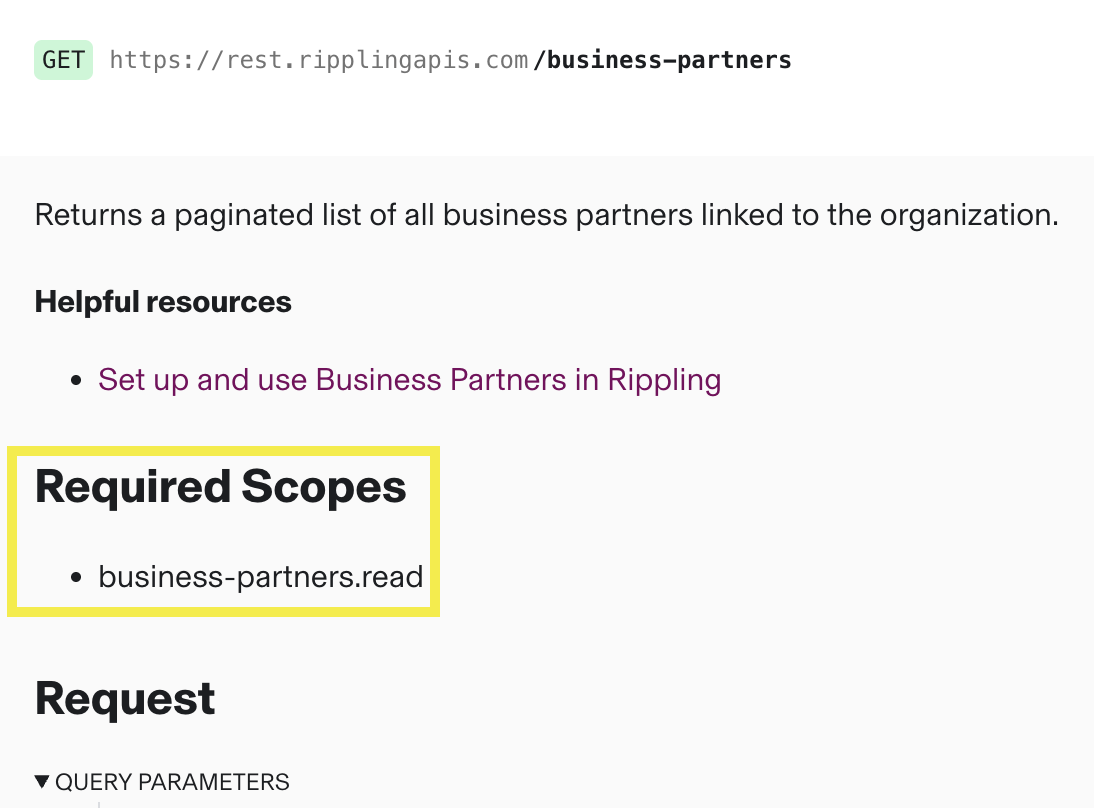
Each endpoint lists its required scopes in the Required Scopes section of the API documentation.
For which Worker, User, and Compensation fields that access includes, see Worker and user field access. For managing access with API tokens and permission profiles, see API Tokens and Permissions.
Call the API
To call an HRIS API endpoint:
- Verify the user’s permission profile and ensure they have the permissions required to access the desired data.
If the user’s permissions are limited (for example, “Basic personal data for direct reports only”):
- Some scopes will not be available when creating the API token.
- The API response will return limited data.
- Create an API token in the Developer app with the required scopes.
- Call the endpoint using the generated token.
Some endpoints require a specific resource ID (for example, a worker_id). In these cases, call the corresponding list endpoint first to fetch the ID (e.g. call GET List workers before calling GET Retrieve a specific worker).
expand your API call to receive a more detailed API response.For example,
GET 'https://rest.ripplingapis.com/workers/?expand=user' will ensure worker and user information is returned (permanent profile number, address, phone number, etc.).Example: GET List compensations
Request:
curl -L -X GET 'https://rest.ripplingapis.com/compensations' \
-H 'Accept: application/json' \
-H 'Authorization: Bearer REDACTED'
Response:
{
  "results": [
    {
      "id": "65699284fb7bc7c3510f452b",
      "created_at": "2023-12-01T08:00:04.090000+00:00",
      "updated_at": "2025-11-23T08:28:35.124000+00:00",
      "worker_id": "65699281fb7bc7c3510f44a6",
      "worker": null,
      "annual_compensation": {
        "currency_type": "USD",
        "value": 250000
      },
      "annual_salary_equivalent": null,
      "hourly_wage": {
        "currency_type": "USD",
        "value": 120.19
      },
      "monthly_compensation": {
        "currency_type": "USD",
        "value": 20833.33
      }
},
],
}